Havant to Ushuaia March 11-14 2018

I got to Heathrow Terminal 5 in plenty of time for my flight to Buenos Aires. At the BA counter they checked me in without fuss but handed me a £10 voucher to use at any of the airport restaurants as the 10 pm flight was going to be delayed till 12 am. I wasn’t particularly hungry so after clearing security I took my time deciding where to eat. I was still feeling a little deflated from the previous day when my choir, Get Vocal, Chichester failed to retain the cup we had won in a singing competition in 2017. In fact we weren’t even runners-up. I have some suggestions for Jo, our leader for next year’s competition. Furthermore, a Gaelic song, one of three we had sung kept repeating itself on me as it was to throughout my Antarctica holiday. I settled on a Giraffe restaurant in the airport departure lounge. I have only recently noticed Giraffe restaurants at airports. Anyway I liked whatever I ate and drank at the restaurant and before long it was time to board BA245 to Buenos Aires. A very pretty robot lady was able to tell us in six languages which train to catch and which stop to get off at to reach the departure gate. I was glad of my aisle seat. Aisle seats allow you to get up as many times as you like without making anybody else get up. I had decided on a recent BA flight to India that I liked BA’s Spanish wines and they are quite generous with them over dinner. Well I had a taste of those on the nearly 14-hour flight to Buenos Aires and they were almost as good as they had been on my Indian flight.

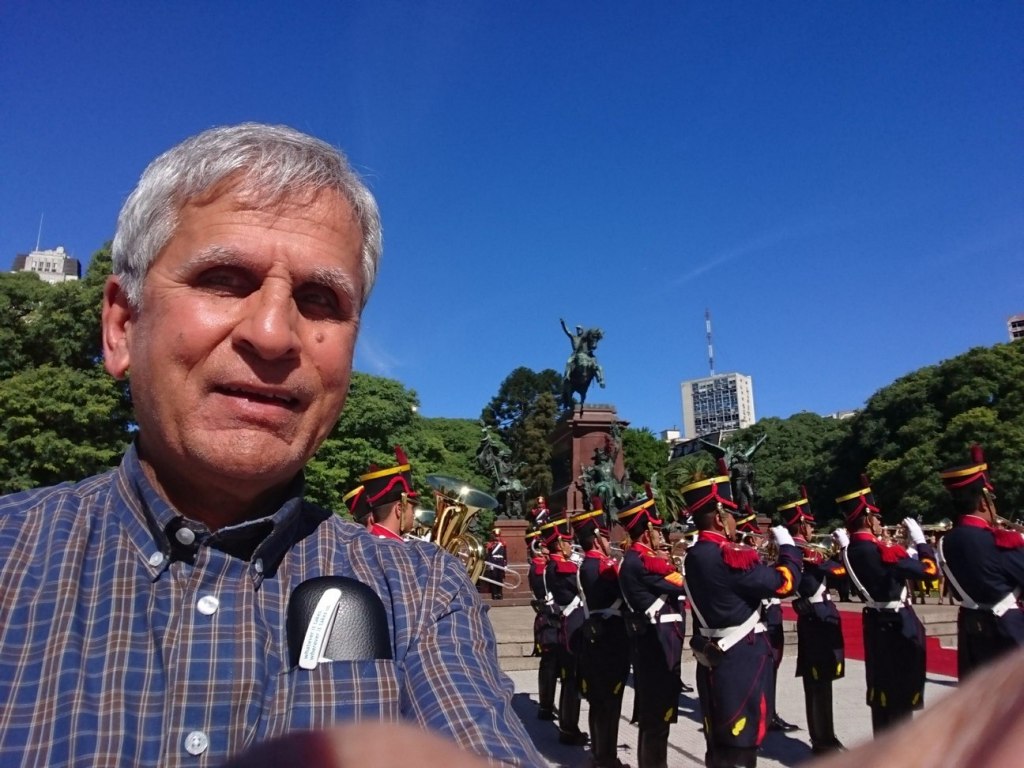


The above is a bust of San Martin I think
At Buenos Aires airport two young ladies received me and others to help transport us to our hotels. In my case this was the N H Crillon, Avenida Santa Fe. At the hotel I rested for a bit and then went out to get lunch. Turning left along Santa Fe I found myself near a Subway restaurant before long. Approaching a young chap at the bar I had the following conversation:
Me: ¿Puedo pagar con mi tarjeta?
Him: Oh yes we take everything except American Express. Are you from London?
Me: No I live south of London
Him: Ah yes Manchester!
Me: No Manchester is to the north of London. I live near Portsmouth (I knew Havant would be hopeless)
Him: Port?
Anyway I enjoyed my toasted sandwich. Exiting the restaurant I turned back towards the hotel. Approaching it I noticed a band playing music at a monument near the hotel. The monument is a statue of San Martin. I watched as in turn three important-looking men came and laid wreaths at the statue. They turned out to be the ambassadors of South Korea, Italy and Peru. I understand that 12th March is “Shield Day” in Argentina and is celebrated all over the country. José Francisco de San Martín was the commander of the armed forces of Argentina, Chile and Peru and helped all three countries achieve independence from Spain. His statue would be an appropriate place to mark the day.
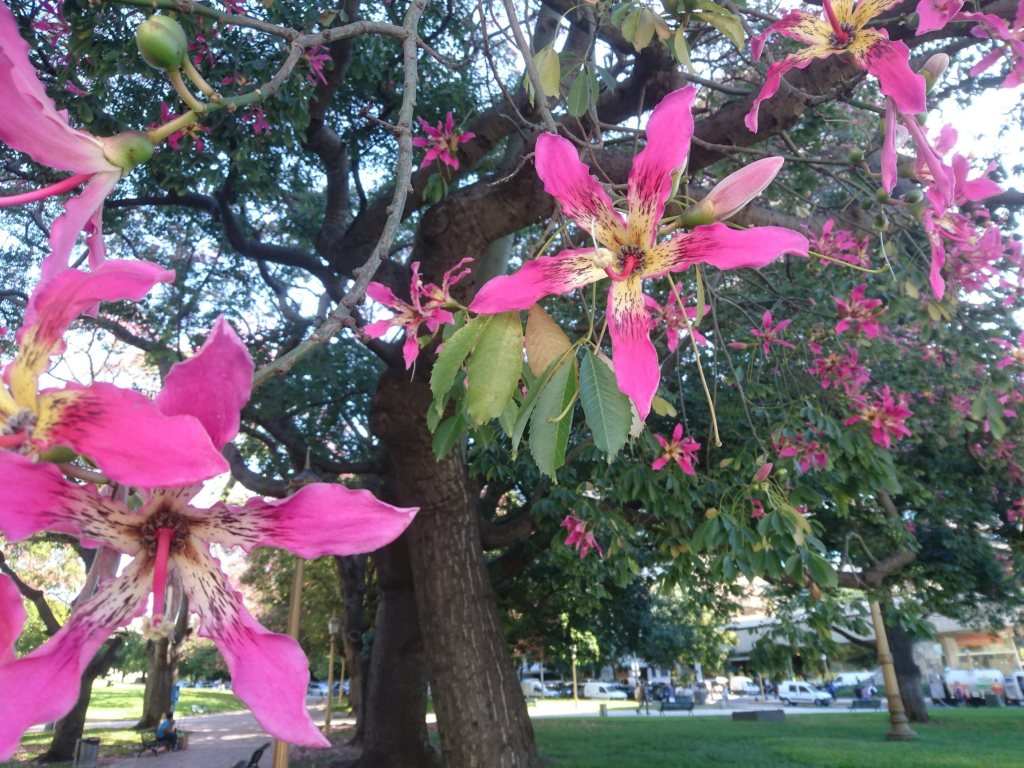
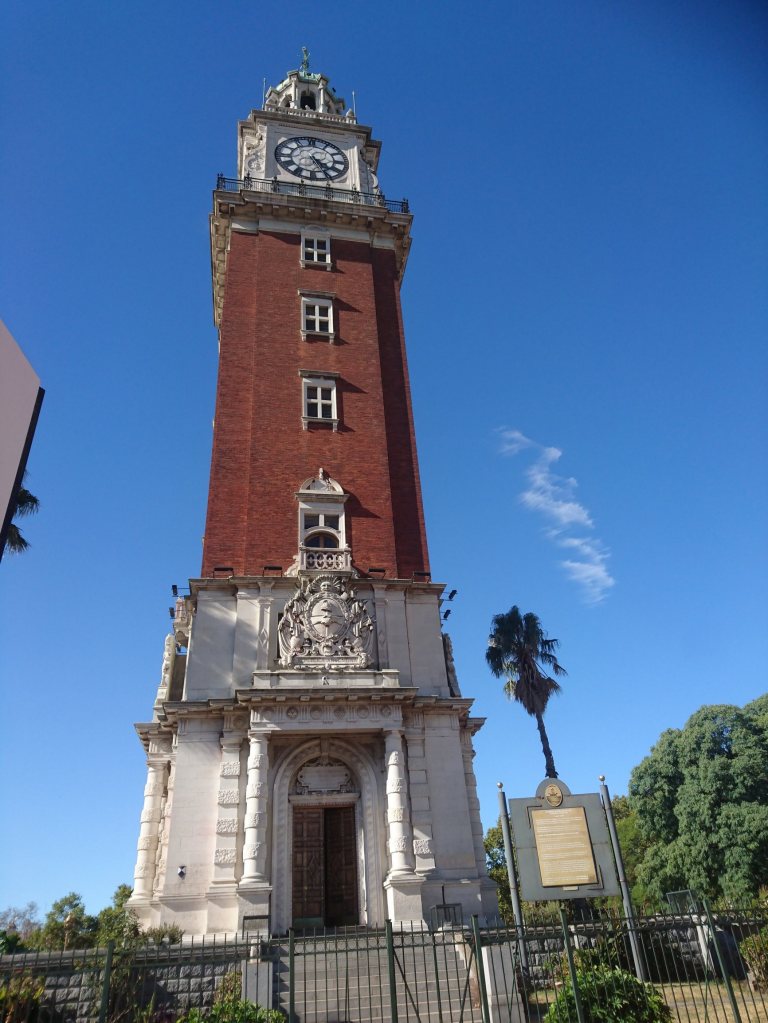
The Crillon hotel is in an attractive and I think very central part of Buenos Aires – I didn’t like the very heavy traffic on Avenida Santa Fe, though. I’ll have to dig up my photos from the year 2000 when I was last in Argentina to see whether I have been to this spot before. I did take pictures of a tree with very pretty pink flowers and of a British-built tower, Torre Monumental – formerly Torre de Los Ingles. There was a flock of parakeets squawking in a little park near the statue. I have seen parakeets in abundance in India but noticed them in England for the first time in the 1980s or 1990s – in Esher. I suppose they had escaped from an aviary or zoo. Since then they have spread and are probably accepted , along with egrets as native British birds.
Strolling around in the neighbourhood it struck me that Buenos Aires is ethnically very European, indeed more so than many European capitals. I don’t remember seeing any people of African, Arab, or Asian origin, though I am told there are lots of Chinese-owned shops in the capital. Looking at the demographics less then 3 % of Argentinians are pure descendants of the indigenous inhabitants. This is so different from Peru and Bolivia where the Quechua and Aymara are everywhere.
I ate at the Dandy restaurant opposite the hotel that evening. The tables on the kerb outside were tempting as it was like a cool summer evening in England but then there were fumes from heavy traffic as well. I went in and found a vacant table, ordered a meal and a glass of wine. A woman possibly in her 50s came over to talk. All I could say was “Perdón Senora” The gist of her response was “it looks as though we won’t be able to communicate”. She approached another man who was on his own. I think they were able to communicate better because I saw him grinning as she left the restaurant. I wonder what the discussion was about!
Early the next morning a taxi took me to the domestic airport for the flight to Ushuaia. I like trying new aircraft types and so I thought the Brazilian Embraer 190 belonging to Aerolineas Argentinas made a nice change from European Airbuses and American Boeings. However they had crammed a few more seats into the aircraft than they should have done for I didn’t find too much leg room when I was seated – and I am not a big man! Ushuaia, at the southern tip of Argentina is 1475 miles from Buenos Aires but only 621 miles from the Antarctic Peninsula. There are no towns of a similar size as far south. No wonder the locals call it Fin del Mundo – end of the world. The flight took about three and a half hours. I tried sleeping, listening to music and reading P G Wodehouse’s “The Mating Season”. I managed a bit of everything. That is how I know that Bertie Wooster’s aunt Agatha chews broken glass and kills rats with her teeth.
I seem to remember a very smooth landing for which I congratulated the crew. I had managed a few of those myself when I had flying lessons many years ago but I was in a Cessna 152 and I gave up for lack of progress. Ushuaia nestles among the Martial Mountains which the locals refer to as the Southern Andes. The airport is picturesque with plenty of snow-covered mountain peaks nearby – yes I took pictures. The organisers of the cruise which was to follow received me and others and transported us to our hotels, mine was the Albatros (no not Albatross) Hotel.
At the hotel there was a briefing, in fact several briefings about what was to happen in the next 24 hours. We were going to be free most of the next day as our cruise was to start in the evening. Would we like to go into the National Park of Tierra del Fuego? While we were doing it would we also like to use a mini train operating in part of the park, the End-of-the-World Train? Later that day I met Sebastian from Böhl-Iggelheim in Germany, not far from the French border. I was already regretting that, to save about £2000 I had agreed to share a two-person cabin on the ship because the sharing was to begin at the Albatros hotel. Sebastian aged 21 is a pleasant enough chap but I didn’t like the idea of sharing a cabin; I was to regret it even more later. I bought a ticket for the national park trip as did Sebastian but in addition I paid for the train ride as well.
After a healthy help-yourself breakfast I set off with other Antarctic adventurers on a coach organised by the excursions company, Rumbo Sur, for the national park. We heard a bit about Ushuaia’s history. It was founded informally in the 1800s by British missionaries and the name is the one used by the indigenous Yámana people. In 1990 the Argentinian government made the archipelago of Tierra Del Fuego a province with Ushuaia as its capital. But by agreement between the two governments the western part of the territory belongs to Chile. In 1896 a prison was set up in Ushuaia to rehouse the most notorious prisoners from Buenos Aires. One of them, we were told, murdered his entire family. He managed to escape from prison but froze to death in the woods. There are features in the national park named after him. I think his name might have been Pipo. However this may be a rumour as I see nothing on Google to confirm the story! The prisoners helped to construct the train line some of us were soon going to use and to cut down trees along its route for house-building. Since 1970 the Argentinian government has encouraged people to move to Ushuaia by making the province a special economic zone and exempting firms and residents from most taxes. In forty years the population has increased from 5000 to around 60000 today.
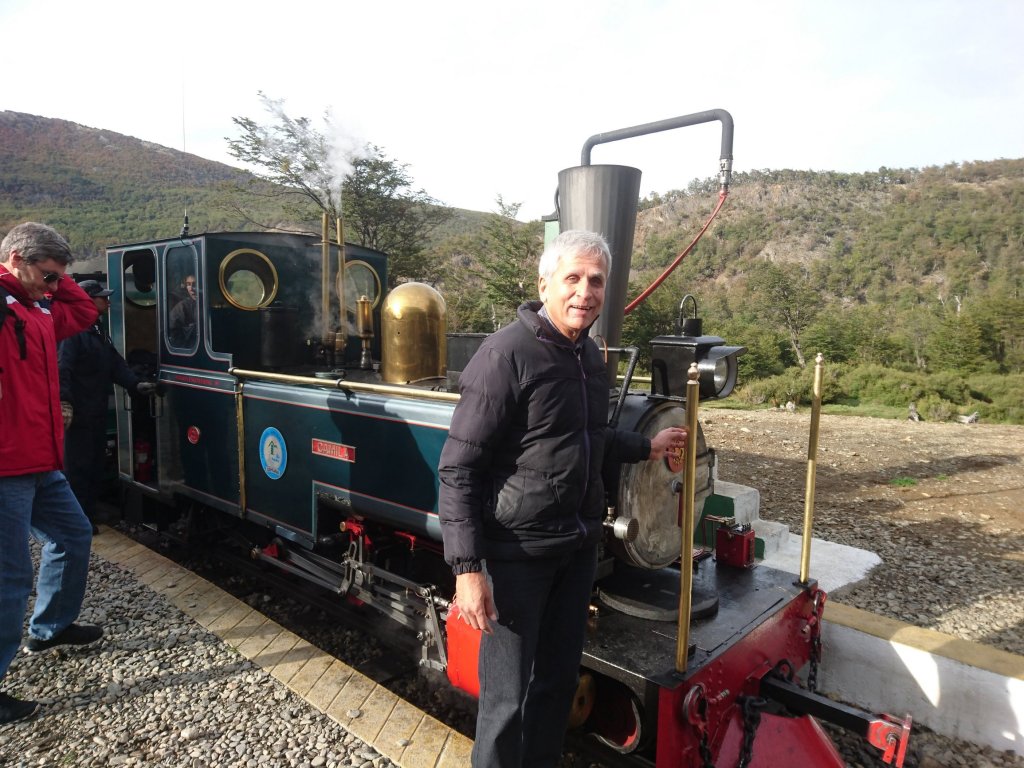
We drove through the Pipo valley, past Susana Mount to the Ferrocarril Austral Fueguino railway station Tren del fin del Mundo where some of us got into the narrow gauge train with a British-built locomotive. Our seven- kilometre journey to El Parque station took one hour but it was through very pretty countryside, woods including stumps of trees which had been cut down by the prisoners or have been cut down since the prison was closed, and snow-covered mountains. En route the train stopped at a waterfall, Cascada de la Macarena. Thereafter we continued by coach to Ensenada bay on the Beagle channel coast, Roca Lake also known as Lago Acigami and Lapataia Bay which is near the southern-most point of the Pan American Highway. We did a bit of walking, some of it along the shore of beautiful Lago Acigami where we were told about the local wild life and fauna. I particularly remember the Upland Geese because we got close to several and they did not seem to mind.
Then it was back to Ushuaia where I had lunch with Sebastian at a steak house near the point of departure for the cruise. A bust of Evita Peron stands near the restaurant (who remembers “Don’t Cry for me Argentina”? With the sort of mind I have I also remember a British comedian singing a follow-up song, “Don’t cry for me Marge and Tina”). Later that afternoon we boarded the ship.
THE DRAKE PASSAGE and AITCHO Islands 14-16 March 2018
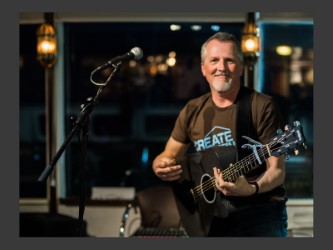
On boarding the ship the first thing I established was that I would not be able to promote myself to a non-sharing cabin. The 105 metre long MS Expedition had its full compliment of 134 passengers and 69 crew and there were no cabins to spare. We went through all the safety drills and were shown the lifeboats and zodiacs – very safe inflatable boats whose design may have been influenced by the ocean explorer Jacques Cousteau. There was a reception with pink sparkling wine for all and we were introduced to the staff, all 69 of them. Not surprisingly the guides all have some specialist interest in Antarctica and most of them were involved throughout the cruise in giving lectures on various aspects of the continent. Several were also skilled zodiac drivers and most were able to lead groups on hikes. One of them was a musician and singer who along with some of the kitchen staff would be providing musical entertainment during the trip.
The passengers were an international mix, the biggest contingent being the Americans (37) followed by the Australians (33) and the Brits (23). There were some 40 , maybe even 50 nationalities represented
Late in the afternoon we set sail through the Beagle Channel (named after Charles Darwin’s ship). On the western side of the channel is Chile and on the eastern side largely Argentina. Most of us took in the views from the outer decks and the lounges inside. It was soon time for our first supper. The food was excellent as it was to be right through the trip with non-vegetarian and vegetarian choices but I definitely preferred the non-veg offerings. The sailing was smooth up to the point at which most of us had finished eating. I think it was then that we moved into the Drake Passage – (named after Francis Drake of course, didn’t the Brits get around?) – and the ship started rolling a bit. It soon got very noticeable and then even a little uncomfortable. When the staff told us that sea was calm I did ask myself “if this is what you call calm what is rough?”
Each of us was lent a pair of boots for our landings and given a parka, a hooded and very warm jacket to use and then keep for good. The organisers were very keen to keep the Antarctic clean – no litter was to be dropped in the course of the landings. Our boots would always be disinfected before we left the ship for a landing and then washed, brushed and disinfected each time we returned from a landing.
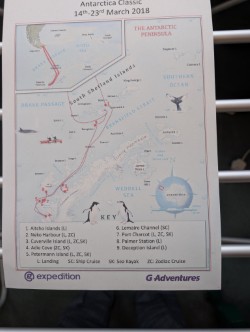
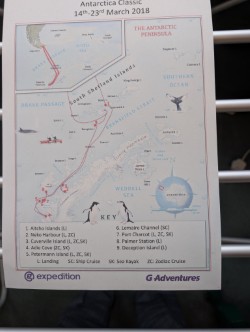
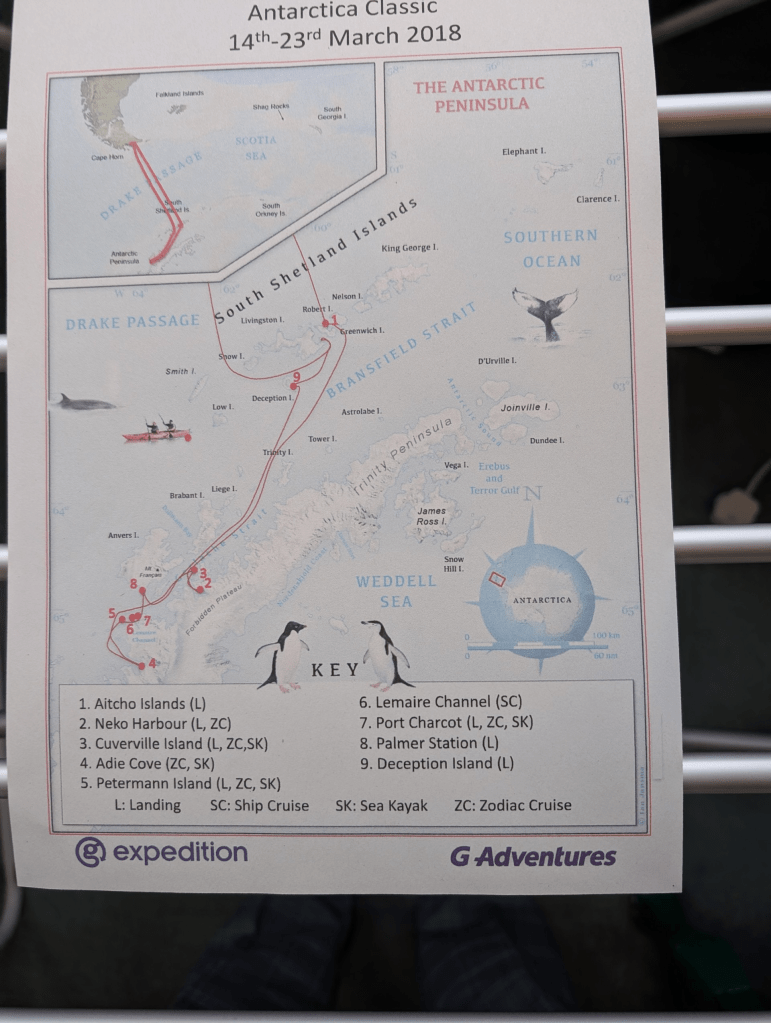
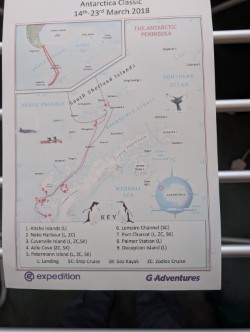
The focus of my trip was to land on continental Antarctica ie to get to a point from which, in theory, one could walk all the way to the south pole and not have to cross any (liquid) water. Looking at the attached map this was going to happen at Neko Harbour. That evening we were all asked to write down our guesses for when we would see our first iceberg – to qualify it would have to be at least as big as a house, our first wandering albatross and, I think, our first whale. Prizes were on offer for the best guesses. I did not win a prize.
Four wandering albatrosses were seen early on March 15. I did not see them and nobody claimed to have taken a photograph. This bird has the longest wingspan of any living bird. It can be up to 3.5 metres. It spends most of its time soaring above the water and lands only to breed. Its brain consists of two halves which take turns at sleeping. This information and a lot more came from our resident ornithologist, Lyn Mair. It is in great danger from longline fishing and Lyn is one of a group who are trying to persuade those who do it to use a specially-designed fish hook which does not trap birds instead of the one they currently use. We were shown a sample.
Our first stop was to be at the Aitcho Islands, specifically Cecilia Island and Barrientos . The Aitcho Islands are part of the archipelago known as the South Shetland Islands. These and the South Orkney Islands may be shown on British maps as British Antarctic Territory. In reality we accept that they are not exclusively British. Seven countries have claims on parts of Antarctica. Some of these overlap. However all seven have signed the Antarctic Treaty 1959. The treaty simply acknowledges that these claims exist but does not accept or dispute them. No further claims will be acknowledged. Nobody will need a passport to go to Antarctica. Anybody can go there and, tour or set up a research station but nobody may make military use of the continent. Many other nations have now signed this treaty. Antarctica either belongs to nobody or to humanity in general. Shouldn’t the whole world be like that? I was told that the original inhabitants of North America did not consider that land could be owned and were surprised when European settlers started fencing off land which they “owned”. One could say those indigenous North Americans were very advanced.
While we were having breakfast on the 16th March a large Finn Whale got very close to the ship. Later we anchored between Cecilia and Barrientos islands. My group was going to land on Barrientos first. We expected to see Gentoo and Chinstrap penguins there. The advice was “don’t get closer than ten yards from a penguin”. If a penguin chose to approach us it was up to it!. We all went through the process of donning our parkas, waterproof trousers, boots and lifejackets and having our boots disinfected before climbing down into our zodiacs.
We landed on both islands and once on there were given some guidance but largely left to do our own thing.
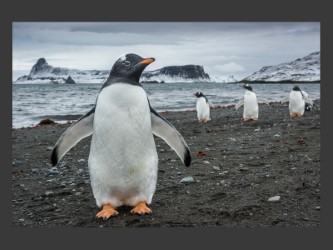
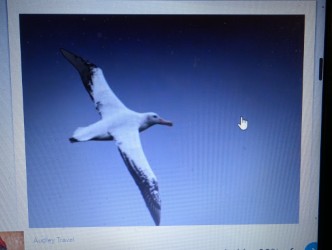
The photographs or illustrations attached show
1 Our planned route
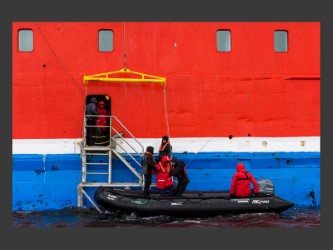
2 getting off the ship and into a zodiac
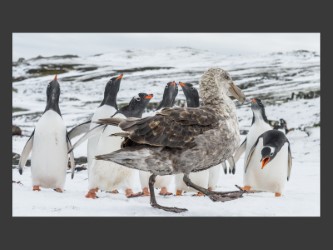
3 A skua looking for a penguin chick meal. It has chosen the wrong time; the chicks have grown up and are able to defend themselves
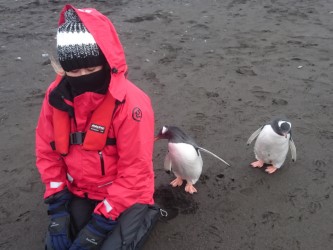
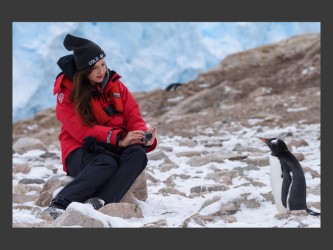
4 A lady has decided to sit down to attract the penguins. She has succeeded and they seem to like her bottom! She asked me to take the photo and email it to her. I obliged.
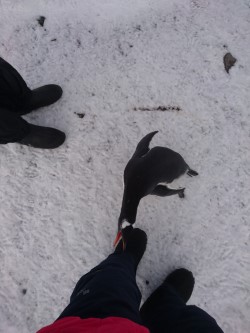
5 I did not sit down but stood still. The penguin approached and is having a go at my waterproof trousers
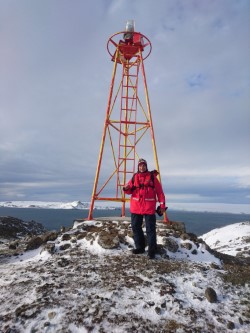
6 Me at a small lighthouse at a high point on Cecilia Island
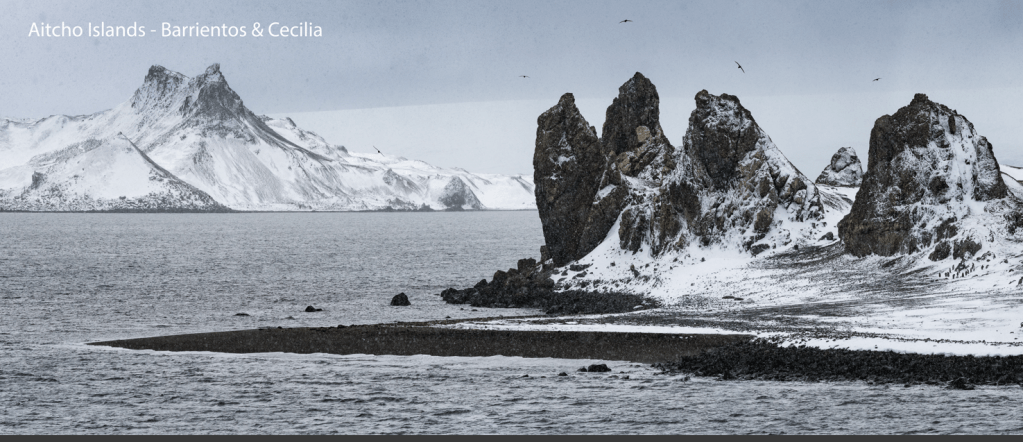
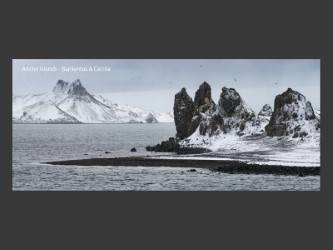
7 A picture of the Aitcho Islands
8 A close-up of a Gentoo penguin. There were chinstrap penguins on the island as well but I don’t remember seeing one
9 A Wandering Albatross
.
NEKO HARBOUR and CUVERVILLE ISLAND 17/3/18
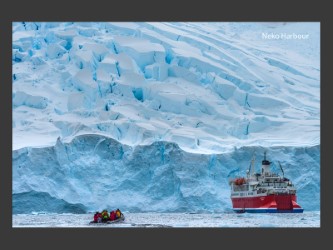
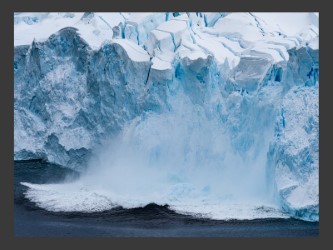
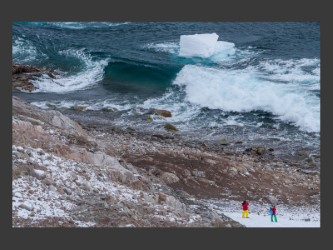
We landed on continental Antarctica at last. This was at Neko Harbour. The pictures I have included here are ones that very good photographers amongst the ship’s crew took. By comparison the ones I took are pathetic! The most spectacular incident here was that there was an avalanche on the island opposite us. A huge chunk of glacial ice plunged into the sea causing a tsunami. We were all at a fairly high level on the mainland and so witnessed the huge waves hitting land. None of us were affected but the penguins were certainly in a hurry scampering up the slope. For them this must be a frequent occurrence.
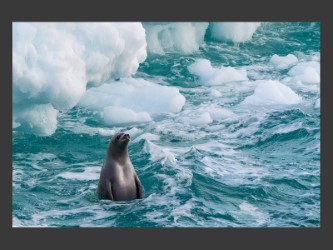
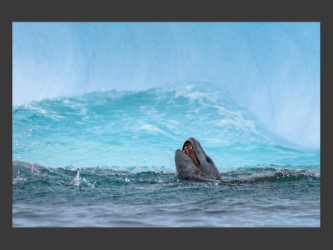
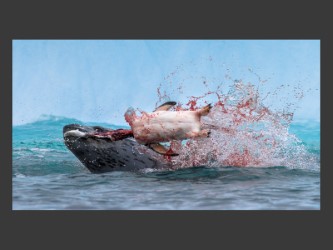
Prior to the landing a leopard seal had followed our zodiac for a bit. These seals do look ferocious but the ferocity is reserved mainly for their prey, penguins for example. I have included pictures of a leopard seal and a penguin kill which one of the other zodiacs witnessed. Unfortunately at breeding time a dead adult penguin will mean a dead chick too. A leopard seal did cause one human fatality which the crew told us about but it was accidental. One of the crew, a naturalist and diver says that he once agreed with some apprehension to dive amongst leopard seals. One of them approached him and got very close – to his consternation. But it went away and returned with an offering – a dead penguin. I don’t think he accepted the gift but probably said “thank you”.
Here is a report of the events of the day by one of the crew:
Glacier-crusted peaks rose into the clouds and all but disappeared into the sky, conveying
the immensity of Antarctica on our first morning in the Gerlache Strait. The spectacular
scenery was dusted with fresh snow, a sign that fall is beginning to set in around the
Antarctic Peninsula. Our ship, the G Expedition, steered into Andvord Bay, an ancient fjord
ringed by 12 miles of tidewater glacier. A strong wind greeted us at the entrance to the bay,
but subsided enough at our anchorage, so that we were able to drop our zodiacs and
conduct our first landing on the “White Continent.”
Neko Harbor provides a wonderful array of sights to whomever
visits. The landing itself is flanked by the wall of a massive
tidewater glacier, one that tumbles down a steep mountainside
that rises high above the small granite spit of land. Gentoo
Penguins nest here, but given the time of year, most of the
adults had gone back out to sea, leaving chicks on the beach to
fend for themselves. These young penguins were taking their
first tentative swims, and were an absolute delight to watch as they recklessly catapulted
themselves around the near shore waters. Zodiacs cruised, and hikers clambered up to a
great overlook of the bay. The nearby glacier had been slightly active during the morning, but
without warning a massive crack resounded throughout the bay and an entire section of
glacier face came crashing down into the bay. The resultant wave powered through the small
harbor, creating a tsunami onshore and wildly rocking the ship at its anchorage.
After a short reposition into the Errera Channel, the ship
came to anchor at a much calmer location north of
Cuverville Island. It was hard not to notice the density of
wildlife surrounding our ship as we began our afternoon’s
operation. We saw a tremendous number of penguins still frequenting the rocky knolls of Cuverville, and the waters were teeming with these birds swimming to and from their feeding grounds. Leopard seals were also plying these same waters, awaiting the young, unsuspecting penguins that would
occasionally dabble into their view.
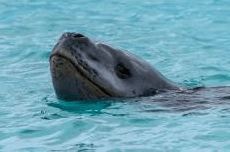
As spectacular as some the leopard seals’ feeding behavior
may have been, the Humpback Whales, which were out in the deeper waters of the channel were the stars of the day. We were privileged to have intimate views of these gentle giants in
the kayaks and Zodiacs. The whales calmly navigated around our tiny craft, some inquisitive, some not bothered at all by our presence.
We left Cuverville this evening, stunned at we had just seen and experienced first-hand.
Antarctica was in peak form today, and as if to add a final exclamation mark, the G
Expedition sailed to its next destination bathed in the pink light of a fall sunset.
Submitted by: Phil Hunter, Kayak Master
The pictures I have included are
1 The route map
2 Neko1 – our ship anchored at Neko Harbour
3 Neko2 – a seal , but I don’t think it is a leopard seal
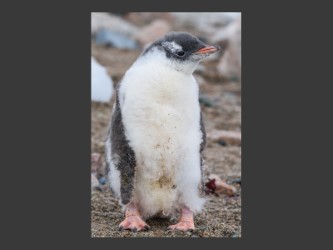
4 Neko3 – a Gentoo penguin chick close to fully grown
5 Neko5 – the avalanche
6 Neko6 – the result of the avalanche it’s not obvious but the people and the penguins are high enough not to be hit by the tsunami
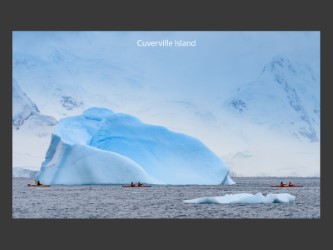
7 Cuverville1 – the island with an iceberg in front
8 Cuverville2 – a leopard seal
9 Cuverville3 – a leopard seal kill
10 Cuverville4 – the tail of a humpback whale
11 One of our entertainers
Adie Cove and Peterman Island 18/3/18
We moved on to Adie Cove today, the southern-most point of our cruise. Adie Cove is part of continental Antarctica but as far as I could tell there was no suitable landing site. This seems to be true of most of the Antarctica Peninsula – I don’t speak here for the rest of continental Antarctica. Glacial ice or large rocks on the peninsula extend right up to the edge of the water making landing difficult. Neko Harbour is an exception. So most of our peninsular landings took place on islands very close to the peninsula rather than on the peninsula itself.
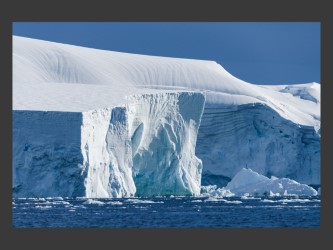
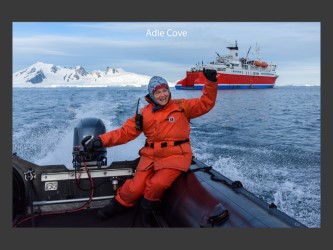
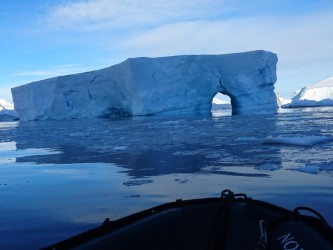
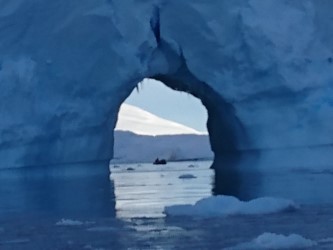
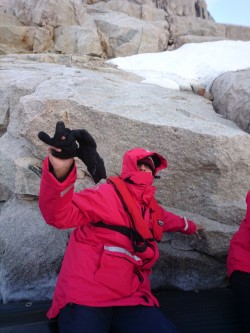
My “landing” at Adie Cove consisted of me perched on my zodiac extending my hand to touch some exposed rocks at Adie Cove (Adie7). The cove has recently acquired it’s name from polar conservationist, Susan Adie who was one of our guides on the expedition. It was here that we saw one of our most interesting icebergs. It had an arch or tunnel (Adie5). My zodiac and another one approached it together. The other zodiac then circumvented the iceberg and got to a position where the two zodiacs could see each other through the tunnel (Adie6).
A Minke whale approached my zodiac and I was concerned when our guide told us it had gone under us. Am I glad it did not flip its tail!
We moved on from Adie Cove to Petermann Island and landed there before moving on towards Port Charcot.
Here is a report by one of our guides:
As we were entering Beascochea Bay the dawn showed soft pink colors above the mountains of the Graham Land
coast. The bay was free of ice except for some humungous tabular icebergs scattered along the way. The ship arrived
by Adie Cove immediately after breakfast, the temperature was -5°C and off we all went for our morning Zodiac cruise.
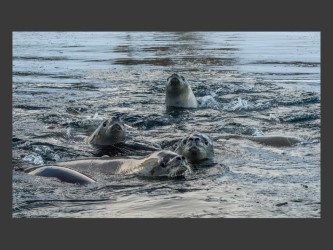
Crabeater Seals welcomed us right at the gangway, looking curiously at us and then suddenly disappearing
with a splash being spooked by us, or so it seemed. Entering deeper into Adie Cove we could see the first signs of winter coming, as some
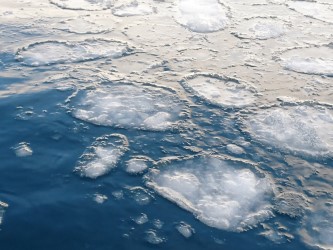
grease ice was forming and in some places, beautiful round pancake ice. A spectacular iceberg with an arch lay inside the bay, intrigued crabeaters came back and forth checking
us out as we were driving in between icebergs. During lunch the ship repositioned to Petermann Island, a historical place where the Ship
Pourquoi Pas led by the Expedition leader Jean Baptiste Charcot from the French Antarctic Expedition of 1908-1910, overwintered.
A scenic hike lead us to a beautiful viewpoint of the Drake Passage and an iceberg-choked bay. Gentoo chicks nearly ready to head out at sea were hanging by the beach side while
moulting adults seemed to be more looking at rockfaces, possibly sheltering from the wind or getting a bit of reflected heat from the rocks. Two lonely Adélie Penguins, showing us their
nice backside and ‘furry’ feet kept playing hide and seek with us until the end. When the ship lifted anchor to reposition to Port Charcot, just a few miles away from
Petermann Island, it sailed through the beautiful Lemaire Channel with Booth Island’s towering mountains (up to 1000 m) on the port side and Graham Land’s glaciers on the
starboard side. The channel was first discovered by Dallmann’s expedition of 1873 but only first navigated by De Gerlache (Belgium Expedition) in 1898. At its narrowest the channel is
800m (0.8mi) wide!
Submitted by: Saskia Travert, Assistant Expedition Leader
The pictures below:
1 Our route
2 Adie1 Approaching Adie Cove
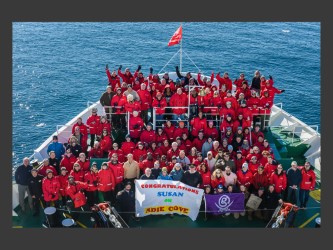
3 Adie2 Tribute to Susan Adie -enlarged version is attached ; find me in it.
4 Adie3 Susan driving our zodiac – enlarged version attached
5 Adie4 Crabeater seals at Adie Cove
6 Adie5 a tabular iceberg with an archway
7 Adie6 we can see the other zodiac through the tunnel
8 Adie7 my “landing” at Adie Cove
9 Adie8 Pancake ice
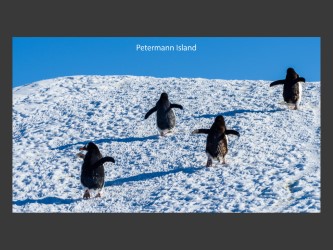
10 Petermann1 Penguins scampering up the slope at Petermann island
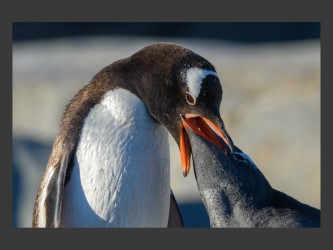
11 Petermann2 Feeding time at Petermann but baby is almost as big as Mummy
12 Petermann3 a view from Petermann Island
13 Peerman4 An Argentinian hut at Petermann Island
14 Lemaire Bound for Port Charcot and approaching the Lemaire Channel – 800 metres wide in places and with icebergs; well done Ship Master.
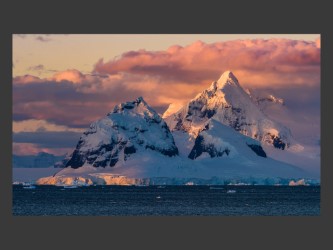
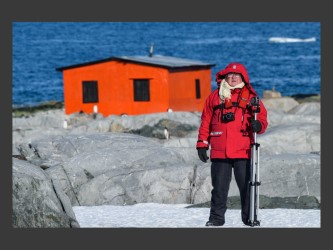
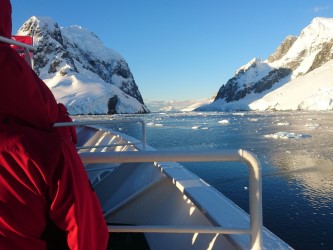
Port Charcot and Palmer Station 19/3/18
My Narrative
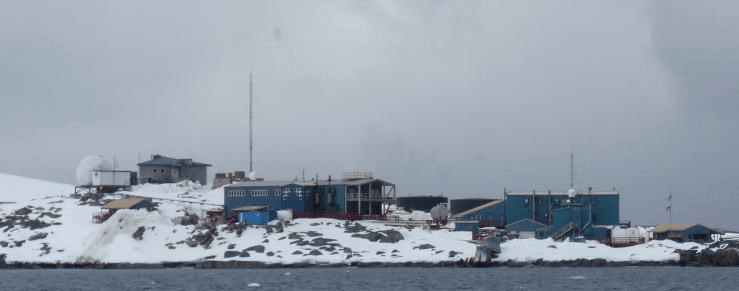
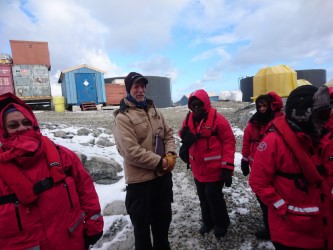
We got to Port Charcot as you can see and explored it for a few hours before moving on to the (American) Palmer Research Station on Anvers island. Individual employees of the station spoke to groups of us about their work. I can’t remember everything that was said but the gentleman who spoke to my group, Geoff or Jeff perhaps, said that climate change was happening and that several nearby glaciers had receded in recent years. He also told us about the station’s desalination plant. When I asked why they needed a desalination plant given that the surrounding icebergs and glaciers were full of fresh if frozen water, he pointed out that water from that source might come blended with penguin guano and seal waste – the words are mine – Geoff delivered the message much more politely. We bought a few souvenirs and some of my fellow passengers had their passports stamped as proof of their visit to the station. I’ll save the blank pages in my passport for when they are really needed! We were treated to chocolate brownies and soft drinks before bidding our hosts goodbye.
Here is the day’s report by one of the expedition staff:
Port Charcot and Palmer Station Monday, 19 March 2018
It was an early rise this morning in order to get out and explore Port Charcot and cruise among the icebergs that get grounded in this area. The weather was a little nasty today as
snow started to fall and cover the landscape as well as us. Those who made the climb to the historic cairn were able to stare out over the bay, admiring the massive
number of icebergs appearing through the snow flurries.This was the area the famous French explorer Jean-Baptiste Charcot wintered in 1904 in his ship the Français and did a great deal
of scientific study on the peninsula. While half the group went to shore, the others took off on a cruise through the ice and snow. Again many Leopard Seals were seen chasing and catching
the poor young penguins, it’s always hard to watch this cat and mouse chase. Not a fair fight at all. There were many Crabeater seals as well, seen moving around the icebergs in groups.
It was nice to get back to our warm ship and grab a warm drink. Once back on the ship we headed to our afternoon landing on Anvers Island, the American Palmer Station. When we arrived,
two members of the Palmer team came on board and gave us the most informative presentation on the science being done by the different teams that do studies
here. We then took off in groups to visit the base where the staff told us what life on the base was like and explained the scientific work done in the different labs and buildings.
The brownies at the main base were a nice treat to end the tour and then we took to the Zodiacs again and rode the choppy waters back to the warmth of the ship.
Another full day and as we finished dinner we all made our way to the lounge to witness the black and white affair and laugh at all the outfits and characters that joined in the fun before
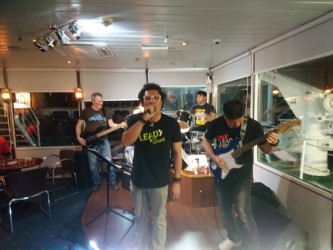
heading to the Polar Bear bar for a night of rock and roll by the crew band, “The Monkey Eating Eagles” live.
Submitted by: Scott MacPhail
Photos by Osi Shahaf: a) Leopard amongst the ice b) Palmer Station.
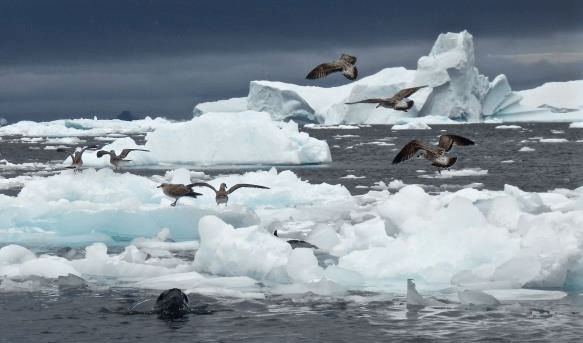
The Pictures below::
1 Antarctic_Route Our route from start to finish
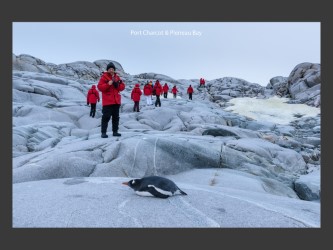
2 Charcot1 As you can see Booth Island at Port Charcot is very rocky.
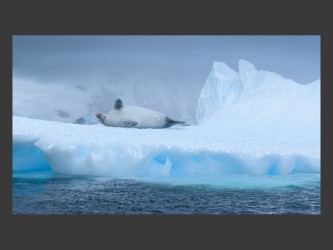
3 Charcot2 a crabeater seal on an iceberg.
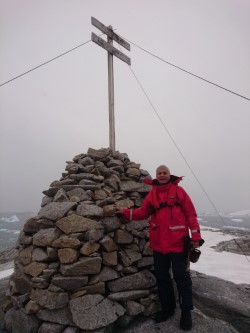
4 Charcot3 me at the cairn on one of Booth Island’s high points
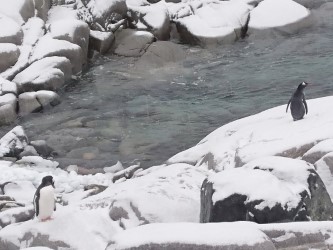
5 Charcot4 I think the penguin on the right is an Adelie Penguin. Our guide told us that the only Adelies she had seen were at that spot. I couldn’t get any closer for a good look. Gentoos of course were everywhere.
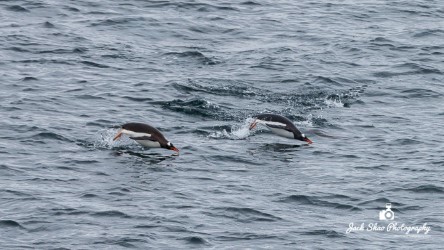
6 JackShaoPenguins. Chinese Australians, Jack and Jill Shao were passengers like me. Jack, a very good photographer with a super camera caught these penguins porpoising.
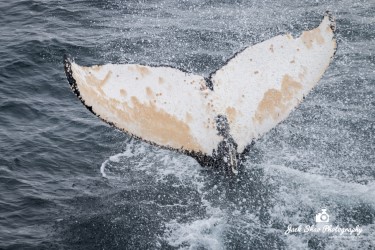
7 JackShaoWhale Jack also got this picture of a whale’s tail above the water. Some of the ship’s experts were very interested. Whale tails can be used to identify individual whales.
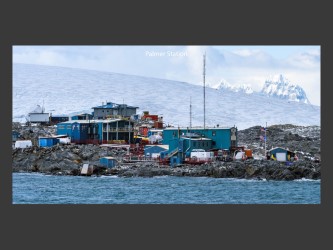
8 Palmer1 The American-owned Palmer Research Station on Anvers Island
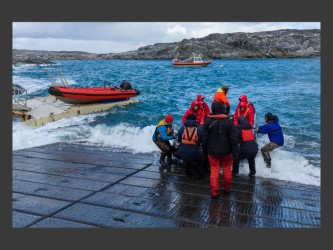
9 Palmer2 A zodiac landing at Palmer station
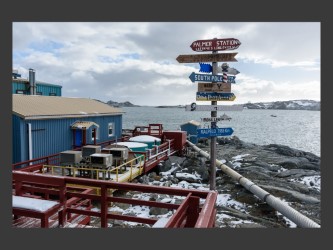
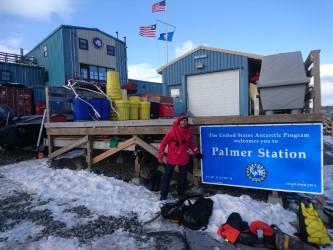
10 Palmer3 A signpost at Palmer Station
11 Palmer4 Geoff (or Jeff perhaps), an employee of the station telling us about the station’s work.
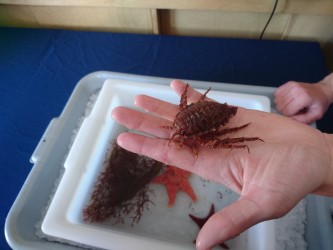
12 Palmer5 A sea creature -I don’t know its name – but one of the researchers at the station was quite happy to put one on the palm of my hand. It didn’t bite, maybe it couldn’t!
13 Palmer6 Posterity will recognize that I have been to Palmer station
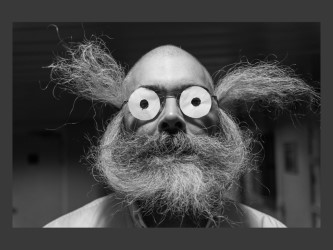
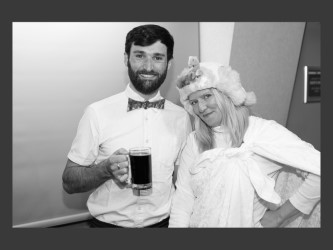
14 AfterPalmer1 One of our guides, Naturalist and BBC documentary maker Gerard Baker shows what he can do with his immensely long beard at Black and White Party night
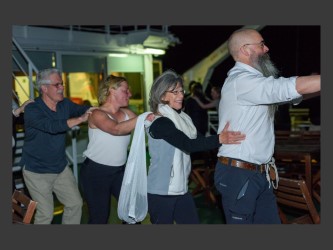
15 AfterPalmer2 Gerard again leading a line of dancers at Black and White Party night.
16 AfterPalmer3 These two do look appropriate at Black and White Party night.
17 AfterPalmer4 Some of the restaurant staff doubling up as a very entertaining dance band.
Deception Island 20/3/18
My Narrative
One of my regrets about the Antarctica Trip is that I did not spend the extra money and get a one-person cabin. Sebastian the young chap with whom I shared my cabin was a pleasant fellow who spoke good English – he admitted that he preferred speaking English to speaking his native German – did not feel well a lot of the time and was in the cabin a lot which did not bother me but he did cough quite badly at night. Not surprisingly I picked up the cough and it stayed with me till about two weeks after my return to the UK
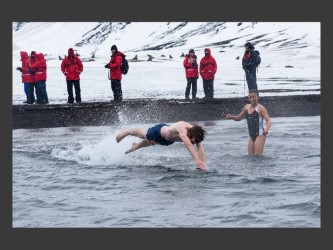
My other regret is that I did not take the polar plunge. I usually take my swim shorts on holiday with me – but why on earth was I going to need them in Antarctica – I thought.
Approaching Deception Island I believed I had a choice of either going on a hike or taking the plunge and I opted for the former. In fact I could have done both. By the time I realised this it was too late. The plunging was coming to an end. I had no swim shorts and no cheek to ask somebody to lend me his!
As Scott MacPhail says below our landing at Half Moon Island had to be abandoned because of bad weather. Am I glad the weather spared us at Neko Harbour. Had we not landed there I would have been frustrated in my main objective of making it to continental Antarctica.
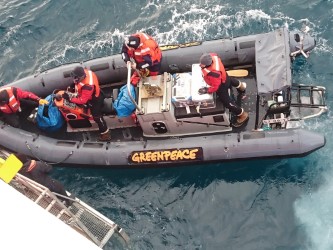
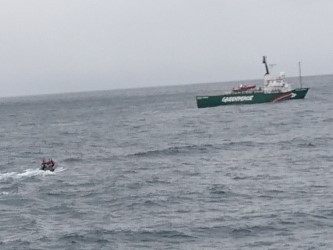
The appearance of the Greenpeace ship later that day was an added bonus. Exactly what mission the ship had in Antarctica on this occasion I don’t know but because one of their crew needed an emergency ride back to Argentina our ship master agreed to the rendezvous.
A Report from one of our guides:
Whalers Bay Tuesday, 20 March 2018
We had traveled north through the night, back to the South Shetland Islands, where we
planned to spend the day exploring. Our morning landing took us to Deception Island where
we entered the caldera of an
active volcano called Port Foster
with a long history of sealing, whaling and science. The narrow entrance is called Neptune’s Bellows, as strong winds
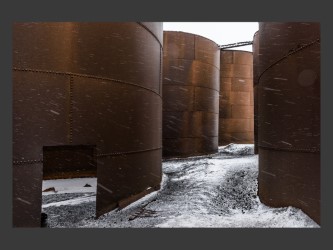
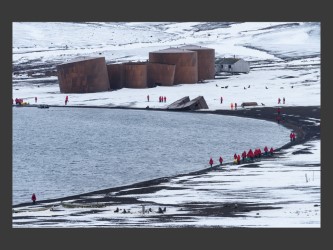
frequently blow through it, and it is less than 500 meters wide where ships must avoid Ravn Rock which lies submerged at the entrance. A lonely whaling wreck lies on the beach to remind everyone how dangerous this is. We anchored at Whalers Bay, where we all admired, the old water boats, the buildings, airplane hangar, blubber ovens and oil tanks that sat along the beach and gave us an idea of what went on during the history of this interesting place. Some of us hiked up to Neptune’s Window, where American sealer Nathaniel Palmer looked out over the Bransfield Strait and saw the continent of Antarctica in
the distance in 1820, while others
the brave took the famous polar plunge into the cold waters, much to the amazement of the Fur Seals that were resting along the shoreline. Well done those who took on the elements, as we immediately rushed them back to the ship for a shower and sauna.
After leaving Deception Island we made our way to Half Moon Island, which is set in a bay off Livingston Island. The winds were strong and the waves were high and the decision was made that the conditions were too dangerous for trying to hold the anchor as well as dropping the zodiacs in these extremes. We left the area and met up with the Greenpeace ship in order to take on a new guest for the ride back to Ushuaia. Steve Blamires took up the afternoon with a presentation on Ernest Shackleton and the Quest expedition he led in 1921 where “the Boss” passed away on arrival to South Georgia. The waves were increasing as we made our way into the Drake passage, heading home.

Submitted by: Scott MacPhail, Historian
Photos by Osi Shahaf: a) Biscoe House b) Monochromatic Deception
The Attachments (photos I took) :
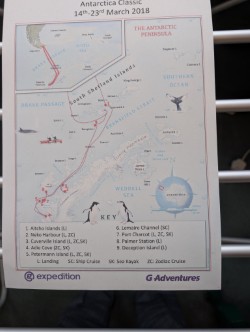
1 Antarctic Route: Our route from Ushuaia to Antarctica and back
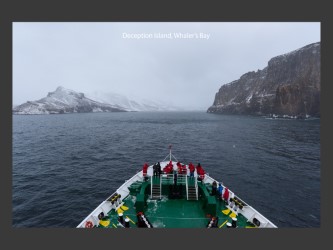
2 Deception1 Approaching Deception Island, Whaler’s Bay
3 Deception2 Disused tanks for whale oil
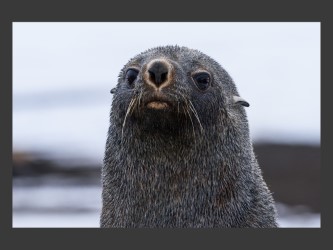
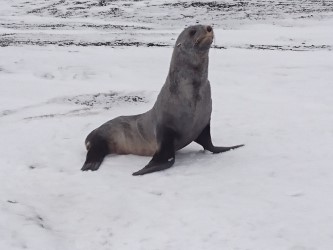
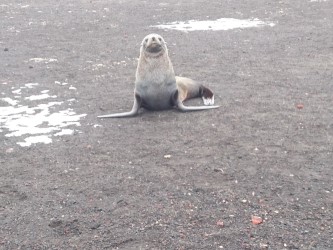
4 Deception3 Fur Seal close-up
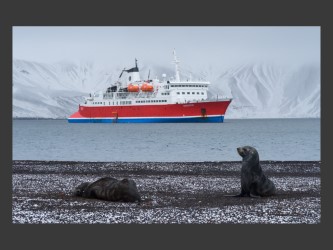
5 Deception4 Fur Seals, Whaler’s Bay and the M S Expedition
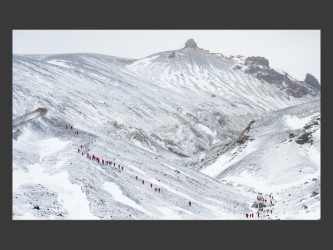
6 Deception5 Starting the hike to the “Nipple” high point
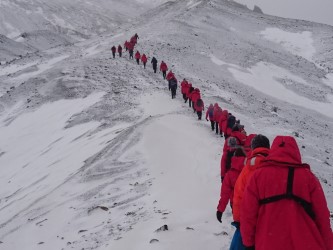
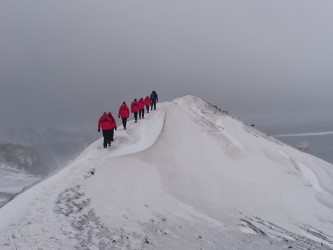
7 Deception6 The hike to the Nipple just before our leader called it off – it was snowing and the surface was getting too slippery
8 Deception7 The alternative hike
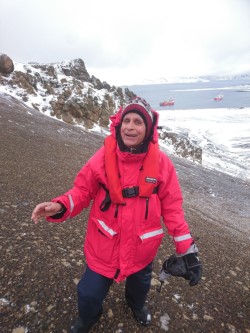
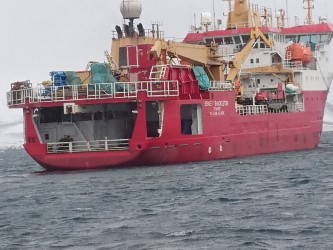
9 Deception8 Me at the end of the hike with the Shackleton and the Expediton in the background
10 Deception9 My own fur seal
11 Deception10 I am a fur seal and you’ve got too close , mister
12 Deception11 The research ship RSS Ernest Shackleton in Whaler’s Bay
13 Deception12 Strolling back to the landing site
14 Deception13 one of my regrets – I did not do the polar plunge
15 Greenpeace1 Rendezvous, a man from the Greenpeace ship wants an emergency lift back to Argentina
16 Greenpeace2 The zodiac returns to the Greenpeace ship, having delivered their man to us.
Antarctic Trip 21-25 March 2018 Drake Passage-Argentina-UK
My narrative:
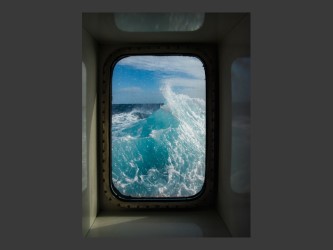
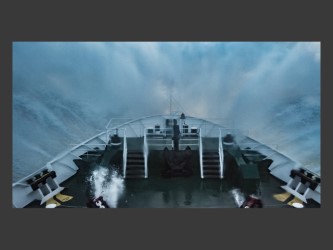
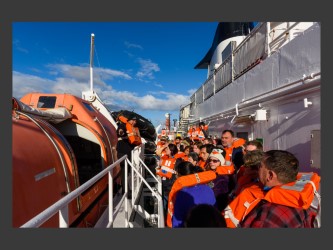
On the night of the 21st March we re-entered the Drake passage and this time it was much more turbulent than on the outward leg. The rolling and pitching of the ship was almost violent. It felt as though the tilt was 5 degrees or more each way. Unless you held on to a railing you were thrown from wall to wall when trying to walk along the corridors. In my case there was a reduction of appetite for the excellent food in the ship’s restaurant. It was amazing to see the waiters balancing food and drink on trays as they served guests. They walked in a way that bodies got tilted but trays never did. They had obviously done this before. A lot of the guests were ill at various times during the tour but they were particularly so now. The outer decks were shut off for the safety of the guests. The attached pictures Drake1 and Drake2 illustrate the need. The Drake passage is definitely not for the faint-hearted
When I got to my cabin that night Sebastian was in bed seemingly fast asleep. And yet I could hear two loud bangs every minute or so coming from the area where our everyday items had been stored. I investigated by torchlight not wanting to wake Sebastian up and found no explanation. I tried sleeping but after about an hour decided to investigate again. The culprit was my bottle of after-shave lotion. To stop my things being shifted around too much by the ship’s motion I had cluttered all my toiletries into one shelf of my allocated little cupboard. The offending bottle was on its own on the top shelf of said cupboard – free to roam as it liked. I moved it to the cluttered shelf and all was well thereafter. But the fact that it did not crack after 300 or so bangs is a good advertisement for Marks and Spencer Woodspice aftershave!
The rough ride on the Drake passage went on for about 48 hours and the Drake’s reputation is well justified. Amazing not only were Francis Drake and Jean-Baptiste Charcot in their sailing ships from years past but also all those modern day sailors who take it on in their bid to circumnavigate the earth.
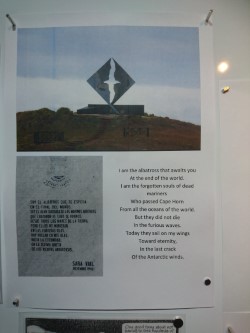
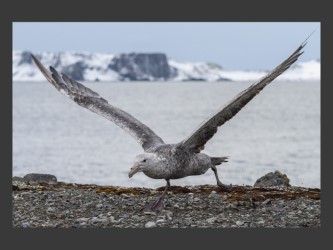
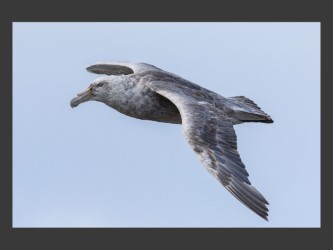
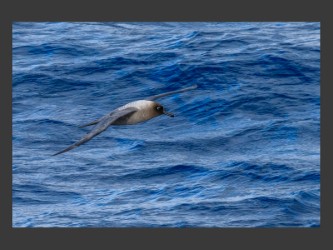
Later we gave the famed Cape Horn the broadside. I failed to spot the almost equally famous Cape Horn Albatross but I have attached a photo that somebody else took.
I met some interesting people on this trip apart from our guides who are renowned scholars and explorers and so on. Sebastian my cabin-mate has travelled to some 40 countries at the age of 21. Have I been to many more? I’ll have to count. Jack and Jill Shao were born in China but live in Australia. Jack and Jill aren’t their original names, I am sure. They were very friendly and Jack, I noticed is an excellent photographer. Ivan, a life-time bachelor aged 68 from Norfolk told me that he had been to 205 countries and still had another 40 or so to do. Thinking about it later I was puzzled. The UN only has 193 members. It recognises another two countries as non-members, Palestine and the Vatican. So what were all these extra countries? It all depends on what is a country. There are some territories that are administered by neighbouring countries but do not belong to them. Thinking about it our country at the UN is the UK but England, Scotland, Wales and Northern Ireland call themselves countries. Even the Isle of Man had a team of its own at the Commonwealth Games and actually won a silver medal. The next time I see my friend Theresa at 10 Downing Street I shall bring up Hayling Island. My beach hut wants a country of its own and we will probably win gold at kite-surfing!
A comment about Argentina: although the Argentinians believe that the Falkland Islands, South Georgia and the South Sandwich Islands belong to them and they have notices in prominent places saying so in English -Ushuaia Airport is called “Falkland Islands Airport” – I found no hostility to the Brits in the short time I spent in the country.
Crevasses
Several of the pictures in my report show crevasses. I did wonder, having heard the stories of South Pole adventurers, Amundsen and Scott as part of our lecture sessions on the ship how they avoided fatalities involving crevasses? What I have seen and heard about glaciers tells me that when walking on a glacier one should have a probe to look for crevasses, hidden or otherwise before every step and yet these two men were in a race to get to the south pole first. I understand that Amundsen’s men were all very good skiers and that they used specially constructed long skis for their attempt. Scott’s men were harnessed to their sledges. Some of them actually fell into crevasses but their harnesses held and they were pulled out shaken but still fit.
My personal experience of crevasses came in 2010 on Mera Peak in Nepal. In 2007, 2008 and 2010 I went trekking in the Nepalese Himalayas getting to 4000 metres in 2007 , 5000 metres in 2008 and aiming for 6000 metres in 2018. I attempted Mera Peak which I was told was about 6600 metres high and could be scaled by a trekker (who was not a mountaineer). But I hadn’t fully appreciated that the peak was glacial which meant there might be crevasses. The day before the attempt on the summit my guide and I spent a few hours in tents at high camp (5900 metres) along with a party of 17 Australians and a UK couple, Ruth and Mike. We had to start our attempt at 2 am. I set off with my Nepalese guide at that hour. We had to fight not only the altitude but a blizzard as well. Only 4 of the Australians actually left high camp for an attempt on the peak but gave up because of the wind and snow. The others were overcome by altitude sickness and didn’t bother to try. I set off with my guide Lakhpa and made very slow progress. I kept stopping after every 20 steps to get my breath back which took more than a minute, perhaps two. We came to a crevasse and found a ladder lying across it. It might have been the fairy godmother’s work. I trusted my guide and followed him across the crevasse. Ruth and Mike also crossed the crevasse with their guide, but soon gave up. Eventually we came to another crevasse and this time there was no ladder. Lakhpa said we would have to give up the attempt; we had no choice. I was disappointed that we did not reach the summit but by Lakhpa’s altitude meter we were at 6450 metres. I did derive some satisfaction from that. It later turned out that there was no fairly godmother; the ladder had been hired by the Australian party and their guide had kindly allowed Lakhpa, Ruth, Mike, their guide and me to use it.
My son-in-law’s brother James, a Kiwi had a much more harrowing experience with a crevasse. James has been doing seasonal work at an Australian research station in Antarctica. Two pilots from the station flew their helicopter to a spot 100 miles away for some routine work. They stepped out of the aircraft and one of them fell into a hidden crevasse. All his fellow pilot could do was to fly back to base to get the rescue equipment plus James and some colleagues. James was lowered into the crevasse, managed to tie ropes round the stricken man’s wrists. He was hauled out and flown back to base alive but approximately 3 hours down the crevasse had reduced his body temperature drastically and they were unable to save him. James said the unfortunate pilot had been his “buddy” and he was most upset. I thought for a while that James would never go back to work at that base again but I understand he has now resumed work there.
But back to the present – the cruise was over. It was Ushuaia, Buenos Aires and back to the UK. I continued to appreciate BA’s Spanish Wine! It was a great holiday. I won’t repeat it in a hurry because it was very expensive and because there are a lot of other things I want to do.
Thanks for reading my report. But do look at the pictures below:
 Devendra Gadgil's Blog